GOD STILL USES CRACKED VESSELS

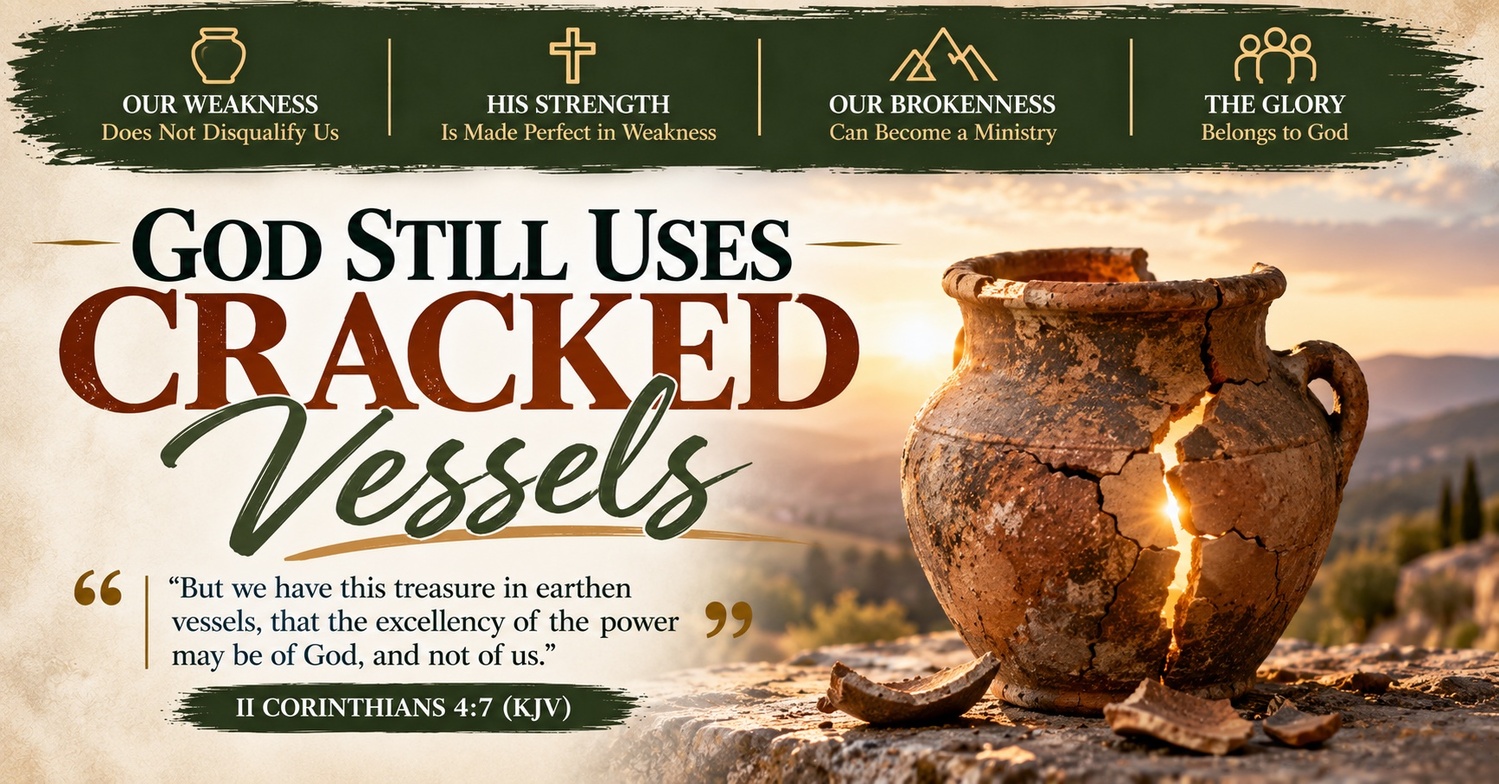
“But we have this treasure in earthen vessels, that the excellency of the power may be of God, and not of us.”
II Corinthians 4:7
Have you ever noticed that God has never had much trouble using imperfect people?
That is good news, because imperfect people are the only kind He has to work with.
When we read the Bible, we sometimes remember its great men and women primarily for what God accomplished through them. But Scripture is remarkably honest about their weaknesses.
Noah got drunk.
Abraham became afraid and lied.
Jacob was a deceiver.
Moses became angry.
David sinned terribly.
Elijah became discouraged.
Jonah ran from God.
Peter denied the Lord.
Thomas doubted.
Paul spoke of a thorn in his flesh.
These were not perfect people.
They were earthen vessels.
And God used them.
Paul wrote:
“But we have this treasure in earthen vessels...”
In Bible times, an earthen vessel was nothing particularly impressive. It was an ordinary container made from clay. It could be chipped. It could be cracked. It could be broken.
Its value was determined largely by what it contained.
Paul says that is what we are.
We are the vessel.
Christ is the treasure.
That changes the way we look at our weaknesses.
God Knows What Kind of Vessel He Chose
Sometimes we imagine that God discovered our weaknesses after He began using us.
He didn't.
God knew Moses had weaknesses when He called him at the burning bush.
Moses protested:
“O my Lord, I am not eloquent...”
Exodus 4:10
Moses saw his weakness as a reason God could not use him.
God saw it differently.
The Lord answered:
“Who hath made man's mouth?... have not I the LORD?”
Exodus 4:11
In other words, God knew exactly whom He had called.
And He knows exactly whom He has called today.
God knows your personality.
He knows your limitations.
He knows your past.
He knows the things you struggle with.
He knows where you are strong and where you are weak.
None of that surprises Him.
A Crack Does Not Make the Vessel Useless
There is a difference between being imperfect and being unusable.
Sometimes Christians decide that because they have failed, suffered, struggled, or been broken in some area of life, God must be finished with them.
That simply isn't true.
Peter denied Jesus three times.
If Peter's story had ended beside that fire, we might remember him only for his failure.
But Jesus wasn't finished with Peter.
After the resurrection, the Lord restored him. Then, on the Day of Pentecost, Peter stood and preached Christ, and about three thousand souls were saved.
The man who had once said:
“I know not the man.”
became the man who boldly proclaimed:
“God hath made that same Jesus, whom ye have crucified, both Lord and Christ.”
Acts 2:36
Peter had been broken.
But he wasn't useless.
Sometimes Our Weakness Makes God's Strength More Visible
Paul asked the Lord three times to remove his thorn in the flesh.
God did not remove it.
Instead, He told Paul:
“My grace is sufficient for thee: for my strength is made perfect in weakness.”
II Corinthians 12:9
We naturally want God to remove our weaknesses.
Sometimes He does.
But sometimes God chooses to demonstrate His strength through them.
If the vessel were magnificent enough, people might admire the vessel.
But God deliberately places His treasure in earthen vessels:
“...that the excellency of the power may be of God, and not of us.”
God does not need us to impress people with how wonderful we are.
He wants people to see how wonderful He is.
Broken Places Can Become Places of Ministry
Some of the most compassionate people you will ever meet are people who have suffered.
Why?
Because they understand.
The person who has buried someone they loved knows how to sit beside another grieving family.
The person who has experienced failure knows how to encourage someone who has fallen.
The person who has lived through a dark valley can turn around and tell someone coming behind them, “Keep going. God will be faithful.”
II Corinthians 1:4 says that God:
“Comforteth us in all our tribulation, that we may be able to comfort them which are in any trouble...”
God can take something that hurt you and eventually use it to help someone else.
The scar remains.
But the scar becomes part of the testimony.
Don't Worship the Vessel
There is another important lesson here.
We should never become too impressed with the people God uses.
Every preacher is an earthen vessel.
Every missionary is an earthen vessel.
Every singer, teacher, deacon, Sunday School worker, and faithful Christian is an earthen vessel.
The treasure is not the preacher.
The treasure is not the singer.
The treasure is not the church worker.
The treasure is Christ.
If God uses us, the glory belongs to Him.
Maybe You Feel Like a Cracked Vessel
Perhaps life has left a few cracks.
Maybe some came through suffering.
Some came through disappointment.
And perhaps some came through mistakes of your own making.
You look at yourself and think:
“Surely God could use somebody better than me.”
He certainly could.
But throughout Scripture, God repeatedly chose ordinary, weak, imperfect people so there would never be any question about where the power came from.
So don't spend your life wishing you were somebody else's vessel.
Give God the vessel you have.
Keep it clean.
Keep it surrendered.
Keep it available.
And let Him decide what He can do with it.
You may have some cracks.
You may carry some scars.
You may not look as impressive as you once thought you needed to look.
That's all right.
The value was never in the vessel anyway.
The value has always been in the treasure.
And God still uses cracked vessels.